Case Study: Macro Story Pacing in Game of Thrones S1 vs. House of the Dragon S2
A visual comparison of of a well-paced story vs. a slow-paced story.

Pacing is a pesky thing in writing. It’s one of the hardest things to analyze in a story. It’s easy to feel when pacing is off, but it’s very hard to articulate the specifics of why. There are also a few different types of pacing:
Macro story-level pacing: the overall speed at which a story unfolds; influenced by the story structure, plot and subplot points, and story beats.
Micro page-level pacing: the speed at which sentences and paragraphs are consumed; influenced by language (e.g. short, simple words can speed up pace) and style (e.g. longer, loftier sentences and paragraphs can slow down pace).
We’re going to talk about the former, macro story-level pacing, in this case study. I find it much easier to visually demonstrate this by looking at two stories on opposite ends of the pacing spectrum.
Game of Thrones Season 1 was an incredibly well-paced story and we can see why when we map out the story beats of the main plot and subplots across tension levels.
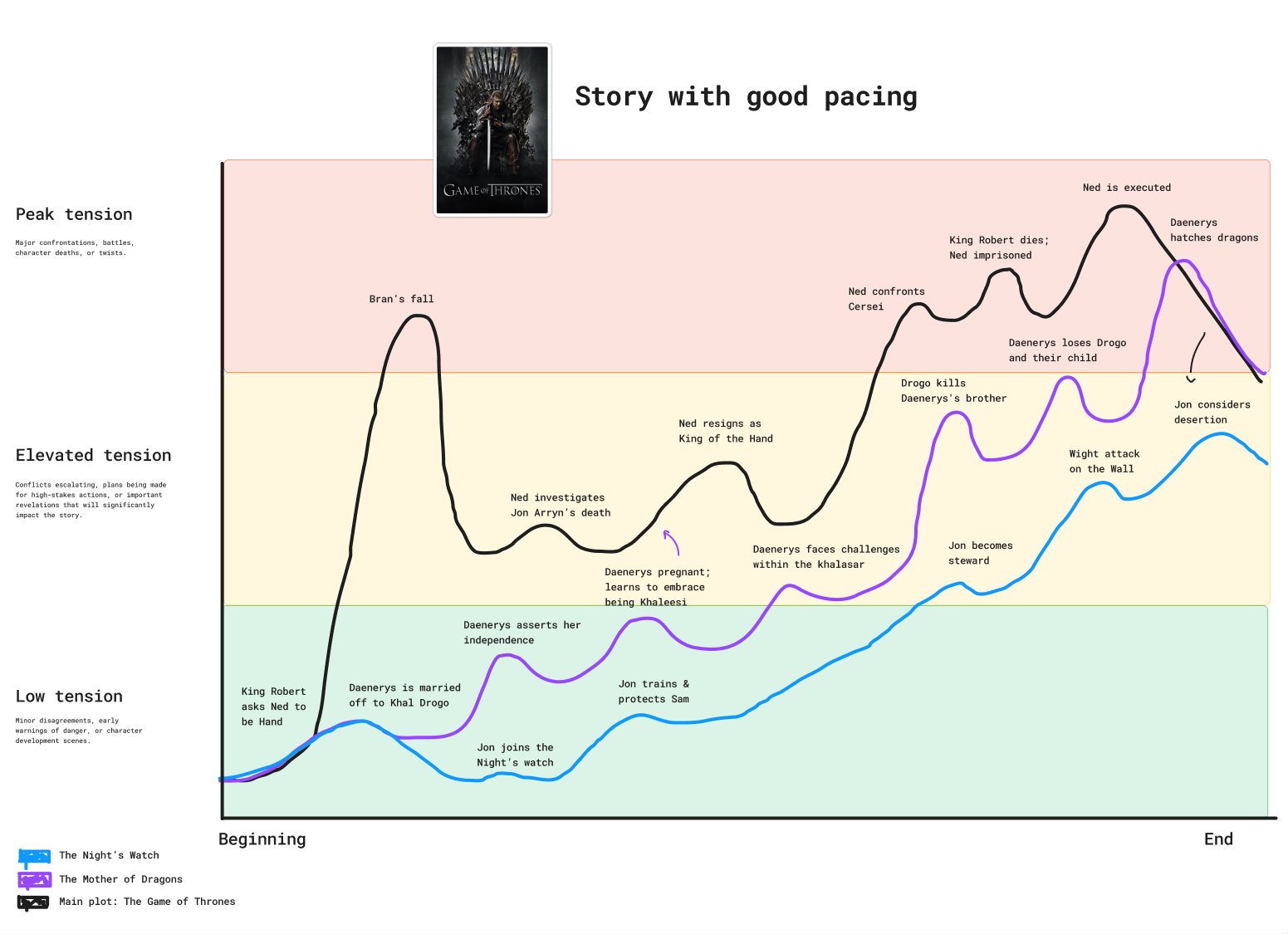
So, why is it good?
Main plot and subplots influence each other.
Example 1: Daenerys' pregnancy causes conflict in the main plot → Robert Baratheon gets paranoid and schemes to poison her → causes Ned Stark to resign as Hand of the King. Daenerys and Khal Drogo learn about the assassination attempt → causes Drogo to vow to conquer the Seven Kingdoms for his unborn son and start marching towards Westeros.
Example 2: Ned Stark dies → Jon Snow considers deserting the Night’s Watch to join Robb marching to war against the Lannisters.
Steady, gradual rise in tension. Each story beat raises the stakes and builds on top of the last.
There is balance. Dramatic scenes are followed by slower, low conflict scenes to give the characters and audience time to process & reflect. The subplots are also used well to create this balance.
Now let’s compare to House of the Dragon Season 2.
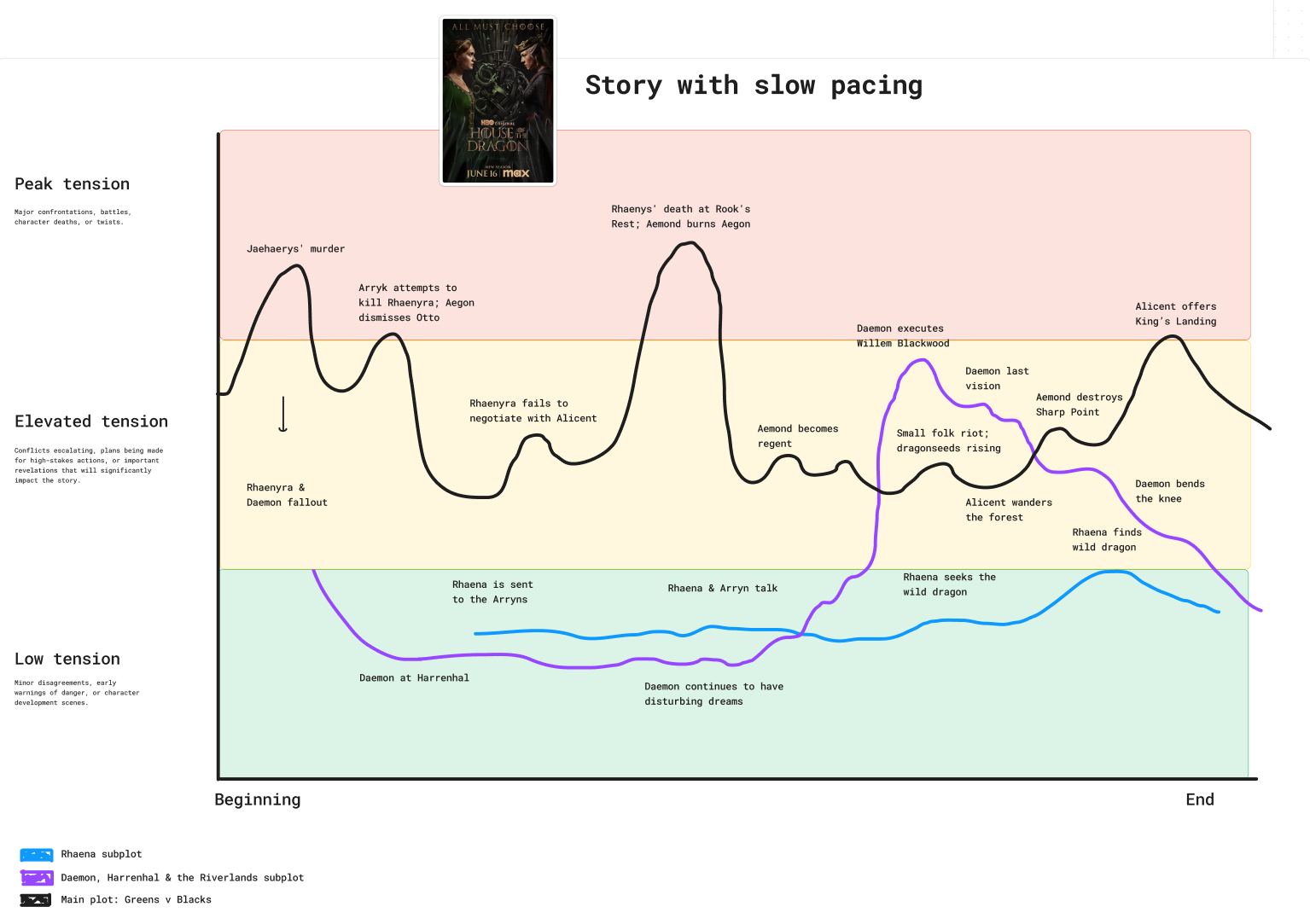
Why it’s not as good:
Main plot and subplots have little influence on each other. Aside from the very beginning of these subplots where Rhaenyra sends Rhaena and Daemon away, there is very little intersection between them.
Unbalanced. Slow scenes are followed by more slow, low conflict scenes.
The faster they rise... Tension should steadily grow throughout the story. Instead, high drama or action scenes are placed early in the season (peaking at episode 4 with the battle at Rook’s Rest). Because there isn’t a natural buildup of tension throughout this season, we’re not really sure what’s going to happen in each episode. We can’t anticipate, and anticipation is critical to building tension.
Can you think of other examples of slow vs. well-paced stories? Drop them in a comment below! And subscribe for more case studies on the art and science of storytelling.
Here are a few other great resources on how to create a well-paced story:
HelloFutureMe has a great youtube deep dive on how to master pacing
Brandon McNulty delves into pacing in this youtube video, including more examples of a well-paced vs. slow story
The Novelry’s guide is rather basic, but does a nice job summing up the fundamentals